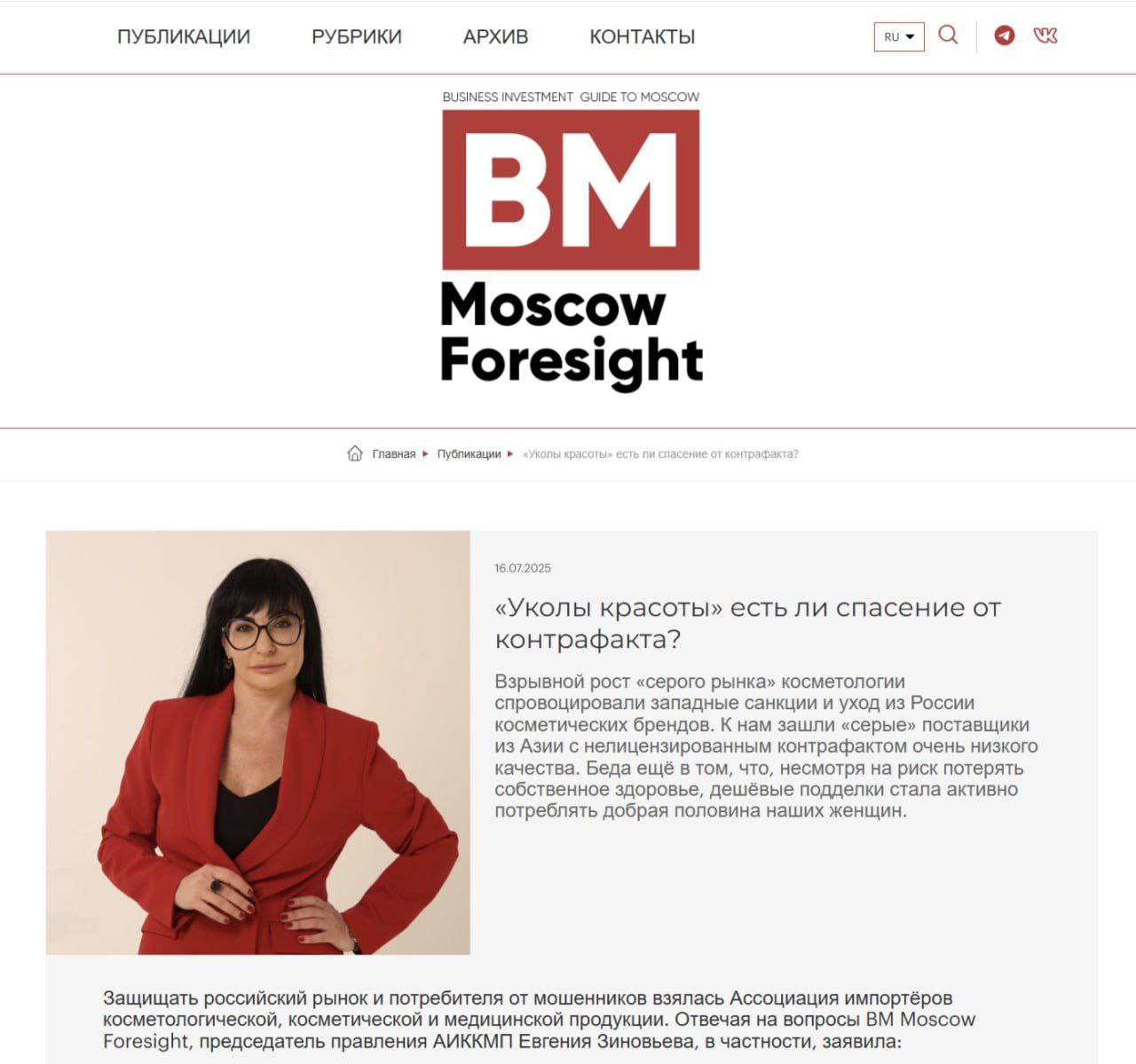
The Moscow Foresight business magazine of the Department of Foreign Economic and International Relations of the Moscow Government published an interview with Evgenia Zinovieva, Chairman of the association, about the problems of counterfeit medical and cosmetic products and the activities of the AICMP in general for foreign entrepreneurs investing in Moscow business.
"Beauty injections" is there an escape from counterfeiting?
The explosive growth of the "gray market" of cosmetology was provoked by Western sanctions and the withdrawal of cosmetic brands from Russia. We were visited by "grey" suppliers from Asia with unlicensed counterfeit goods of very low quality. The trouble is that, despite the risk of losing their own health, a good half of our women began to actively consume cheap fakes.
The Association of Importers of Cosmetology, Cosmetics and Medical Products undertook to protect the Russian market and consumers from fraudsters. Responding to questions from BM Moscow Foresight, Evgenia Zinovieva, Chairman of the Board of the AICCMP, stated, in particular:
— According to various open sources, currently between 10% and 55% of illegal injectable aesthetic medicine products are in circulation in Russia: botulinum toxins, intradermal implants (fillers), biorevitalizants, as well as surface anesthetics, which often accompany the use of injectable drugs.
Experts estimate the turnover of unregistered or counterfeit drugs and medical products for the beauty industry at 100 billion rubles, which is 40% of the total market.
Now we are talking only about registered products, but do not forget about the growing number of unregistered products that are freely sold through marketplaces and used uncontrollably, often independently at home. This criminal sector is not officially controlled by anyone, as Roszdravnadzor carries out inspections only of those organizations that have a medical license.
A major problem remains the lack of awareness of patients, as well as those "nedokosmetologov", about the dangers of improper use of beauty products. Neither doctors, much less patients, think about checking the drug for state registration, and even those who think about it often do not know how and where to get this information.
In addition, there is a problem of poor-quality training of specialists, as well as a huge number of those who, without medical education, earn money from "beauty injections" in premises that do not have a license for medical activity.
— Evgenia Vladimirovna, you head the largest Association in Europe. What do you see as the goals and objectives of your mission?
— Today, the AICCMP is a unique organization in its functions, scope and capabilities. We bring together business representatives in the beauty industry, manufacturers of cosmetic and medical products, part of the medical community and end users, patients.
We are aware that it will not be possible to solve all the problems overnight, therefore, from the very beginning, the range of priority tasks facing the AICCMP has been defined.
The Association is primarily concerned with protecting all participants in the Russian market from counterfeit products. We have a system for accounting for original products and quality control of goods, as well as monitoring clinics and doctors for compliance with professional activities.
One of the difficult tasks facing the AICCMP is to reduce the negative consequences of receiving counterfeit products. We pay serious attention to consumer information support in the field of aesthetic medicine.
I have listed the priority tasks of the AICCMP, but there are other pressing requests that members of the Association address: issues of state registration, inspection, taxation, customs regulation, and many others.
— How was the Association of Importers of Cosmetology, Cosmetics and Medical Products created?
— The Association was established in 2023. One day, one of its members, an exclusive distributor of a Korean manufacturer, asked for support when it became clear that the products, which were in the process of state registration at that time, were on the market as counterfeit products and without his knowledge. The examination conducted after the control purchase confirmed the unoriginality of the products. The manufacturer suspended the production line, and this product was no longer supplied to the markets of other countries. However, would-be entrepreneurs from the southern regions of Russia decided not to stop the "production" of fake Korean and Chinese brands and flooded the market with counterfeit goods. The investigative authorities have opened a criminal case under Article 238.1 of the Criminal Code of the Russian Federation.
During the search, the operatives seized counterfeit products worth a total of 50 million rubles from the fraudsters. There was a trial and a verdict, the perpetrators were severely punished and imprisoned for a long time.
Constantly faced with various problems of fraud and counterfeiting and the lack of judicial practice in applying penalties under Article 238.1 of the Criminal Code of the Russian Federation, it became obvious to specialists that the time had come to create a non-profit organization to combat the existing problems of the aesthetic market. This is how the Association of Importers of Cosmetology, Cosmetics and Medical Products was born.
— What measures do you propose to combat counterfeiting?
— It has become extremely difficult to deal with sellers and suppliers of illegal products, as well as with home-based doctors who provide unlicensed services. Administrative cases against such scammers are initiated in isolated cases.
According to the Administrative Code, the fine for such violations for the first time is 2.5 thousand rubles, which, of course, is not a deterrent. At the same time, if individuals provide aesthetic services without a license, they simply do not fall under the supervision of Rospotrebnadzor or Roszdravnadzor. There are also two criminal articles (171 and 235), but their defendants are only those who cause serious harm or death to patients.
It is time to change the legislation: it is necessary to classify all individuals (including the self-employed) providing aesthetic services as those that fall within the scope of supervision by supervisory authorities.
It is also important to introduce quantitative accounting (strict prescriptions and special storage conditions) for drugs of the botulinum toxin group. Even the instructions for them stipulate that they need to be stored in special conditions, and used only in a clinic setting. Today they are quietly sold to individuals.
I also believe that doctors who provide aesthetic medicine services at home should be stripped of their licenses, because they pose a threat to the health and lives of patients.
As for our Association, we work with the problems of substandard cosmetic products at various levels of implementation and promotion of social projects, legislative initiatives, and also educate the public and cosmetologists, telling them about the need for patients to use only registered products.
In my opinion, several effective solutions have been developed with our assistance to combat the "gray" segment of the counterfeit and substandard products market. In particular, we have attracted IT specialists who have helped us create an unparalleled tool for checking medical devices: the Telegram bot "Medinspektor". With it, you can quickly and easily check the availability of a registration certificate for a medical device by several parameters — both by the name of the product and by the name of the manufacturer.
In addition, during a control check via a bot, it is easy to send a message to the Association about the identification of a substandard or simply questionable medical device or an already occurring complication of human health. I would also like to draw your attention to the fact that when buying medical products on marketplaces, even with a registration certificate, you cannot be sure that the rules of storage and transportation are followed.
Both doctors and patients can check the product. I would like marketplaces to use a bot before placing a product on the marketplace. We are also working on this, but, alas, this is not a quick story.
— The media reported on the initiative to create an innovative system in Russia for labeling original products with high-reliability protective labels. Tell us about it.
— A special marking of products based on high—resolution anti-coke compounds, which are now used as a protective label on banknotes, dollars and rubles, has been developed and is already being applied in practice. So far, this is the only method of protection that cannot be forged or duplicated, such as a QR code.
This marking has several degrees of protection, one color or a combination of them, it is also resistant to aggressive media: acids, alkalis and high temperatures. And the check is carried out by a convenient light "detector" in the form of a compact and accessible "pencil-flashlight".
— How profitable is it to be a member of the Association for companies wishing to gain a foothold in the Russian market?
— It is beneficial for any manufacturer or its representative in Russia to join the Association today, since any honest business requires expert support. And we do this at any stage of the life cycle of a product that is supplied to the Russian market.
— Is there international cooperation on combating counterfeiting today?
— I must say that fruitful cooperation is underway on various issues, including the requests of the Association's members regarding the safety of cosmetic, cosmetic and medical products. Currently, for example, a partnership agreement has been signed with the Trade Department of the Embassy of the Republic of Korea in Moscow.
— Russia remains the largest consumer of cosmetics in Eastern Europe with a share of about 50%. Do you think the same alarming situation on the counterfeit market will continue in our country in the coming years, or will cosmetic and cosmetology "monsters" from France, Great Britain, Spain and Italy take over?
— I think that the situation with the oversaturation of the Russian market with fake cosmetology, cosmetic and medical products will change for the better. We must defeat counterfeiting! After all, our country, taught by bitter experience, is extremely interested in obtaining only high-quality products, especially for the maintenance of the beauty industry.
The Association of Importers of Cosmetology, Cosmetics and Medical Products undertook to protect the Russian market and consumers from fraudsters. Responding to questions from BM Moscow Foresight, Evgenia Zinovieva, Chairman of the Board of the AICCMP, stated, in particular:
— According to various open sources, currently between 10% and 55% of illegal injectable aesthetic medicine products are in circulation in Russia: botulinum toxins, intradermal implants (fillers), biorevitalizants, as well as surface anesthetics, which often accompany the use of injectable drugs.
Experts estimate the turnover of unregistered or counterfeit drugs and medical products for the beauty industry at 100 billion rubles, which is 40% of the total market.
Now we are talking only about registered products, but do not forget about the growing number of unregistered products that are freely sold through marketplaces and used uncontrollably, often independently at home. This criminal sector is not officially controlled by anyone, as Roszdravnadzor carries out inspections only of those organizations that have a medical license.
A major problem remains the lack of awareness of patients, as well as those "nedokosmetologov", about the dangers of improper use of beauty products. Neither doctors, much less patients, think about checking the drug for state registration, and even those who think about it often do not know how and where to get this information.
In addition, there is a problem of poor-quality training of specialists, as well as a huge number of those who, without medical education, earn money from "beauty injections" in premises that do not have a license for medical activity.
— Evgenia Vladimirovna, you head the largest Association in Europe. What do you see as the goals and objectives of your mission?
— Today, the AICCMP is a unique organization in its functions, scope and capabilities. We bring together business representatives in the beauty industry, manufacturers of cosmetic and medical products, part of the medical community and end users, patients.
We are aware that it will not be possible to solve all the problems overnight, therefore, from the very beginning, the range of priority tasks facing the AICCMP has been defined.
The Association is primarily concerned with protecting all participants in the Russian market from counterfeit products. We have a system for accounting for original products and quality control of goods, as well as monitoring clinics and doctors for compliance with professional activities.
One of the difficult tasks facing the AICCMP is to reduce the negative consequences of receiving counterfeit products. We pay serious attention to consumer information support in the field of aesthetic medicine.
I have listed the priority tasks of the AICCMP, but there are other pressing requests that members of the Association address: issues of state registration, inspection, taxation, customs regulation, and many others.
— How was the Association of Importers of Cosmetology, Cosmetics and Medical Products created?
— The Association was established in 2023. One day, one of its members, an exclusive distributor of a Korean manufacturer, asked for support when it became clear that the products, which were in the process of state registration at that time, were on the market as counterfeit products and without his knowledge. The examination conducted after the control purchase confirmed the unoriginality of the products. The manufacturer suspended the production line, and this product was no longer supplied to the markets of other countries. However, would-be entrepreneurs from the southern regions of Russia decided not to stop the "production" of fake Korean and Chinese brands and flooded the market with counterfeit goods. The investigative authorities have opened a criminal case under Article 238.1 of the Criminal Code of the Russian Federation.
During the search, the operatives seized counterfeit products worth a total of 50 million rubles from the fraudsters. There was a trial and a verdict, the perpetrators were severely punished and imprisoned for a long time.
Constantly faced with various problems of fraud and counterfeiting and the lack of judicial practice in applying penalties under Article 238.1 of the Criminal Code of the Russian Federation, it became obvious to specialists that the time had come to create a non-profit organization to combat the existing problems of the aesthetic market. This is how the Association of Importers of Cosmetology, Cosmetics and Medical Products was born.
— What measures do you propose to combat counterfeiting?
— It has become extremely difficult to deal with sellers and suppliers of illegal products, as well as with home-based doctors who provide unlicensed services. Administrative cases against such scammers are initiated in isolated cases.
According to the Administrative Code, the fine for such violations for the first time is 2.5 thousand rubles, which, of course, is not a deterrent. At the same time, if individuals provide aesthetic services without a license, they simply do not fall under the supervision of Rospotrebnadzor or Roszdravnadzor. There are also two criminal articles (171 and 235), but their defendants are only those who cause serious harm or death to patients.
It is time to change the legislation: it is necessary to classify all individuals (including the self-employed) providing aesthetic services as those that fall within the scope of supervision by supervisory authorities.
It is also important to introduce quantitative accounting (strict prescriptions and special storage conditions) for drugs of the botulinum toxin group. Even the instructions for them stipulate that they need to be stored in special conditions, and used only in a clinic setting. Today they are quietly sold to individuals.
I also believe that doctors who provide aesthetic medicine services at home should be stripped of their licenses, because they pose a threat to the health and lives of patients.
As for our Association, we work with the problems of substandard cosmetic products at various levels of implementation and promotion of social projects, legislative initiatives, and also educate the public and cosmetologists, telling them about the need for patients to use only registered products.
In my opinion, several effective solutions have been developed with our assistance to combat the "gray" segment of the counterfeit and substandard products market. In particular, we have attracted IT specialists who have helped us create an unparalleled tool for checking medical devices: the Telegram bot "Medinspektor". With it, you can quickly and easily check the availability of a registration certificate for a medical device by several parameters — both by the name of the product and by the name of the manufacturer.
In addition, during a control check via a bot, it is easy to send a message to the Association about the identification of a substandard or simply questionable medical device or an already occurring complication of human health. I would also like to draw your attention to the fact that when buying medical products on marketplaces, even with a registration certificate, you cannot be sure that the rules of storage and transportation are followed.
Both doctors and patients can check the product. I would like marketplaces to use a bot before placing a product on the marketplace. We are also working on this, but, alas, this is not a quick story.
— The media reported on the initiative to create an innovative system in Russia for labeling original products with high-reliability protective labels. Tell us about it.
— A special marking of products based on high—resolution anti-coke compounds, which are now used as a protective label on banknotes, dollars and rubles, has been developed and is already being applied in practice. So far, this is the only method of protection that cannot be forged or duplicated, such as a QR code.
This marking has several degrees of protection, one color or a combination of them, it is also resistant to aggressive media: acids, alkalis and high temperatures. And the check is carried out by a convenient light "detector" in the form of a compact and accessible "pencil-flashlight".
— How profitable is it to be a member of the Association for companies wishing to gain a foothold in the Russian market?
— It is beneficial for any manufacturer or its representative in Russia to join the Association today, since any honest business requires expert support. And we do this at any stage of the life cycle of a product that is supplied to the Russian market.
— Is there international cooperation on combating counterfeiting today?
— I must say that fruitful cooperation is underway on various issues, including the requests of the Association's members regarding the safety of cosmetic, cosmetic and medical products. Currently, for example, a partnership agreement has been signed with the Trade Department of the Embassy of the Republic of Korea in Moscow.
— Russia remains the largest consumer of cosmetics in Eastern Europe with a share of about 50%. Do you think the same alarming situation on the counterfeit market will continue in our country in the coming years, or will cosmetic and cosmetology "monsters" from France, Great Britain, Spain and Italy take over?
— I think that the situation with the oversaturation of the Russian market with fake cosmetology, cosmetic and medical products will change for the better. We must defeat counterfeiting! After all, our country, taught by bitter experience, is extremely interested in obtaining only high-quality products, especially for the maintenance of the beauty industry.
Sourse: BM. Moscow Foresight